2934 mots | Temps de lecture : 14 minute(s)
Racing side-cars: the driver, the monkey and the three-wheeled machine
Racing & circuitsSide-carWorld championship
Born in 1949 alongside the 500, 350, 250 and 125 classes, the side-car category left the Grands Prix after the 1996 season. In between, the near-production outfits powered by the BMW Rennsport twin gave way to ultra-low Swiss chassis, engine behind the driver and an acrobatic passenger hanging out over thin air. Rolf Biland, seven times world champion and eighty Grand Prix wins, forced the FIM to rewrite its rulebook. On the Isle of Man, the Sidecar TT has been run since 1923 and now laps at more than 121 mph.
Contents
- Two people, three wheels: a sport of its own
- The “monkey”: the passenger without whom nothing turns
- From the production outfit to the ultra-low “worms”
- 1949-1996: the side-car in the world championship
- Rolf Biland, the engineer who made the FIM back down
- Sidecar TT and endurance: the great classics
- Side-car cross: the same madness in the mud
- Summary table
- FAQ
Two people, three wheels: a sport of its own
On a side-car grid, you don't count machines: you count crews. Two people, three wheels, one single lap time. It's the only discipline in motorcycle sport where the result is signed with two names, and where the second one isn't a passenger but a working part of the machine. The rulebook of the FIM is crystal clear on the subject: the driver sits ahead of the engine, on his knees, hands close to the front wheel, while the passenger moves around the platform, shifting his weight from left to right and from front to back to improve traction and cornering speed.

Three wheels, two lunatics and a chassis skimming the tarmac: that's what your wall is missing. Poster format, framing of your choice.
Nothing to do, then, with the family outfit or the Russian-style utility side-car whose military and road use are recounted by the story of the Ural brand . In racing, the machine is a prototype skimming the tarmac, closer to a single-seater than to a motorcycle, and the pair driving it takes forces that the solo Grand Prix classes simply never see.

The “monkey”: the passenger without whom nothing turns
In the jargon, the passenger is called “the monkey”. The nickname says it all: at 200 km/h he hangs his upper body off the platform, clings to a set of grab handles, throws himself from one side to the other at every change of direction and acts as a counterweight, like a dinghy crew hiking out. In a right-hander he comes down hard on the chair wheel; in a left-hander he swings to the outside to stop the outfit rearing up and taking off. A passive “monkey”means a lost lap time and, often, a trip into the gravel.
This role has another peculiarity: it has always been open to women at the highest level, at a time when the solo Grands Prix were discouraging them. The German Ingeborg Stoll-Laforge, passenger for her own father and then for the Frenchman Jacques Drion, shared with him the international podiums of the 1950s and death, at the Czechoslovak Grand Prix at Brno in 1958. The Englishwoman Dane Rowe, for her part, teamed up with the Swiss rider-engineer Rudi Kurth. And because the title is won by two, the passenger is crowned just like the driver: the very first world champion in the category, in 1949, shared his crown with a certain Denis Jenkinson — the same man who, six years later, would act as Stirling Moss's navigator on the 1955 Mille Miglia.
From the production outfit to the ultra-low “worms”
Until 1977, racing side-cars stayed surprisingly close to the ones out on the road: a classic outfit stripped of its chair body, with lowered suspension and the tank and battery moved around to bring the centre of gravity down. The king of engines in that period has a name: the BMW Rennsport, a double-overhead-cam flat twin. Its flaws in solo trim — the rocking torque caused by the longitudinal crankshaft, the protruding cylinders that rule out any lean angle — turned into virtues on a slammed outfit nicknamed the “basset”, with its shaft drive and its flat engine. The story of that engine is worth a detour through the BMW Motorrad epic.
The first revolt came from outboard engines : Rudi Kurth's Swedish three-cylinder Monark-Crescent, then the flat-four König with its rotary valve. Light and powerful, they suffered from two flaws: cooling calibrated for sea water, and no gearbox — so they had to graft on the ancient separate four-speed box from the Norton Commando, reworked into five or six speeds by Rod Quaife, which coped badly with the extra power. The Frenchman Alain Michel settled the matter by adapting a Yamaha OW31, a two-stroke four-cylinder designed for motorcycles from the outset, gearbox included — the same engine as the one in the fearsome TZ750.
On the chassis side, the revolution is Swiss : Hermann Schmidt, Eric Vuagnaz with his Seymaz, and above all Louis Christen with the famous LCR, still the benchmark of the discipline today. As early as the start of the 1970s, Rudi Kurth was drawing up a very low outfit with a stainless-steel beam frame, 10-inch wheels and flat Dunlops some fifteen centimetres wide. Today's machines are the end point of that logic: single-beam chassis, four-stroke engine placed behind the driver, enveloping bodywork, wide tyres with a rectangular section. The long Formula 1outfits, engine at the driver's back, inherited the nickname “worms” — so endless is their silhouette that it seems to ripple through the corners; the Formula 2machines, for their part, tuck a 600 cm³ under the driver's chest, for a much shorter wheelbase.
🏍️ A “worm” silhouette skimming the tarmac is something worth looking at every day: see the motorcycle posters and prints.

1949-1996: the side-car in the world championship
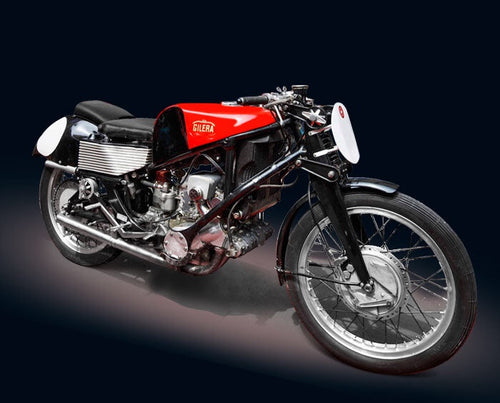
The side-car class has been there since day one. In 1949, when the FIM launched the world road racing championship, five classes were on the programme: 500, 350, 250, 125 and side-car, then limited to 600 cm³. Only three rounds counted for the outfits that year — Switzerland, Belgium, Italy — and the Englishman Eric Oliver, with Denis Jenkinson in the chair, won the first two on a Norton. The title was settled before the Monza finale even started, won there by the Gilera ofErcole Frigerio, runner-up in the championship. Oliver would pocket four titles in all.
Then came the German era. Wilhelm Noll won in 1954 on a BMW: the start of a staggering run of dominance, with 19 world titles gathered by the Munich marque between 1954 and 1974. Klaus Enders alone claimed sixof them, backed up by four wins at the Sidecar TT. Later, the Englishman Steve Webster set the outright record for the discipline: ten world crowns between 1987 and 2004, with four different passengers. Only one Frenchman appears on the roll of honour: Alain Michel, crowned in 1990 on an LCR-Krauser with the Englishman Simon Birchall, at 37, after finishing runner-up in the world championship three times.
For a long time the outfits raced on the same tracks as the solos, from the “Cathedral” of Assen all the way to Laguna Seca. Then the axe fell: the 1996 season was the side-car's last on the Grand Prix programme. The discipline carried on outside the GP paddock and, at the turn of the 2000s, took the name Superside, as a curtain-raiser to the Superbike world championship, before the FIM took the organisation back over in 2010 under the name FIM Sidecar World Championship. The latest big technical turn came in 2017 : the engines, which until then went up to 1 000 cm³, were brought back down to Supersport-homologated 600 cm³ four-cylinders in order to bring budgets down.
Rolf Biland, the engineer who made the FIM back down
Born in 1951, the Swiss Rolf Biland is both the most decorated driver of his generation and the one who gave the technical stewards the most trouble: seven world titles (1978, 1979, 1981, 1983, 1992, 1993 and 1994) and 80 Grand Prix wins. His great coup dates from 1978 : he won the championship with the BEO, a machine designed like a Formula 1 car, beam chassis, rear engine, two driven wheels with a Porsche-principle differential, and a passenger, Ken Williams, sitting outright in a bucket seat. The “monkey” had nothing left to do: the chassis was neutral.
The FIM cut to the quick. For 1979, it split the category in two: B2A for traditional chassis, B2B for prototypes. Biland grabbed the B2A title with Kurt Waltisperg, while Bruno Holzer took B2B on an LCR. In 1980, the federation banned prototypes outright, citing costs and the fear that side-cars would no longer look like motorcycles. Faced with a revolt from the competitors, it backtracked as early as 1981 and set the rules that still hold today: drive through the rear wheel only, a single steered wheel — the front one, controlled by handlebars —, a passenger who must be active, and a maximum offset of 75 mm between the front and rear tracks, which in practice rules out trikes and cyclecars. Biland would bow out at the 1997 Austrian Grand Prix, his last win dating back to the 1996 Catalan Grand Prix.
Sidecar TT and endurance: the great classics
On the Isle of Man, three-wheelers have been part of the scenery since 1923. That year, 14 outfits set off on the 37,73 miles of the Mountain Course; Freddie Dixon won on a Douglas with a banking side-car in 2 h 07 min 48 s, at 53,15 mph on average. For lack of enough entries, the ACU struck the class from the programme as early as 1926. It came back in 1954 on the Clypse Course of 10,79 miles, then returned to the Mountain Course in 1960 — and has never left it since. The full story of the event is told in the Tourist Trophy epic, where you also come across the indestructible Joey Dunlop.
Since 1990, the Sidecar TT has been run to Formula 2 rules: two-strokes up to 350 cm³ or four-strokes up to 600 cm³, the latter having long since swept the former aside. The figures are dizzying: Dave Molyneux holds the record for wins with 17 victories ; the Ben and Tom Birchall brothers piled up fourteen together until Tom's retirement, announced at the end of 2023, the very year they pushed the lap record to 120,645 mph (18 min 45 s 85). In 2025, Ryan and Callum Crowe became the first to break the 121 mph barrier, at 121,021 mph.
Endurance racing, for its part, welcomed outfits from the very beginning. The very first Bol d'Or, in 1922, was run as two consecutive 24-hour races: one for motorcycles, one for side-cars and cyclecars, with 12 outfits on the start line. They were still to be seen on the grid in the 1950s. Closer to us, a world championship round was held at the 2010 Bol d'Or at Magny-Cours, and Le Mans, home of the 24 Heures Motos, regularly appears on the side-car calendar.
🏁 To keep a trace of these improbable machines on a shelf, take a look at the miniature motorcycles.
Side-car cross: the same madness in the mud
The side-car also has its off-road version, and it is spectacular. After a FIM Cup launched in 1971, then a European championship from 1975, the side-car cross world championship came into being in 1980. The principle stays the same — the passenger hanging out to the side, one foot in mid-air, to load the right wheel in the ruts — but with long-travel suspension and engines allowed from 350 to 750 cm³ in two-stroke or up to 1 000 cm³ in four-stroke.
The undisputed master of the discipline is the Dutchman Daniël Willemsen, ten times world champion, his last title dating from 2012, often on Zabel-VMC machines. Alongside the Motocross des Nations, side-car cross remains a curiosity for the general public — and a religion for those who have seen it up close.
Summary table
| Key point | Verified fact |
|---|---|
| Creation of the side-car class in the world championship | 1949, alongside the 500, 350, 250 and 125; capacity 600 cm³ |
| First world champion | Eric Oliver / Denis Jenkinson, on a Norton |
| BMW dominance | 19 world titles between 1954 and 1974 |
| Exit from the Grand Prix programme | After the 1996 season (then Superside, FIM from 2010) |
| Current world championship capacity | 600 cm³ four-cylinder four-stroke since 2017 |
| Rolf Biland | 7 titles (1978, 1979, 1981, 1983, 1992, 1993, 1994), 80 GP wins |
| Record holder for titles | Steve Webster, 10 crowns between 1987 and 2004 |
| Only French world champion | Alain Michel, 1990, on an LCR-Krauser |
| First side-car race at the TT | 1923, win for Freddie Dixon at 53,15 mph |
| Sidecar TT lap record | 121,021 mph by Ryan and Callum Crowe in 2025 |
| Record for wins at the Sidecar TT | Dave Molyneux, 17 victories |
| Side-car cross world championship | Since 1980; Daniël Willemsen, 10 titles |
FAQ — Frequently asked questions
-
In what year did the side-car class appear in the world championship?In 1949, the very year the world road racing championship was created, alongside the 500, 350, 250 and 125 cm³ classes. Eric Oliver and his passenger Denis Jenkinson were crowned on a Norton after only three rounds, in Switzerland, Belgium and Italy.
-
When did the side-car leave the Grands Prix?After the 1996 season. The discipline then became Superside, as a curtain-raiser to the Superbike world championship, before the FIM took the organisation back over in 2010 under the name FIM Sidecar World Championship.
-
How many world titles did Rolf Biland win?Seven: 1978, 1979, 1981, 1983, 1992, 1993 and 1994, for 80 Grand Prix wins. The outright record belongs to the Englishman Steve Webster, ten times world champion between 1987 and 2004.
-
How long has the Sidecar TT been running on the Isle of Man?Since 1923, with a first win for Freddie Dixon on a Douglas at 53,15 mph on average. Dropped from the programme in 1926, the race came back in 1954 on the Clypse Course, then on the Mountain Course from 1960.
-
What is the passenger, nicknamed “the monkey”, there for?He shifts his weight around the platform, from left to right and from front to back, to load the driven wheel and stop the outfit taking off in corners. The FIM rulebook requires him to be active: without him, the machine doesn't turn.