2355 mots | Temps de lecture : 11 minute(s)
The Yamaha TZ750: the two-stroke nobody really dared to tame
Iconic models70s YamahaRacing two-strokes
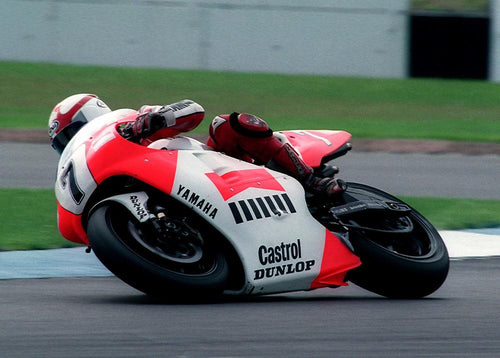
Unveiled in 1974, the Yamaha TZ750 was born from two TZ350 engines bolted together: a water-cooled four-cylinder two-stroke of 694 cm³ credited with 90 horsepower, taken out to 747 cm³ from 1975 and up to 120 horsepower by the end of its career. Giacomo Agostini won with it at Daytona on its very first outing, opening nine consecutive wins in the Florida classic and total domination in Formula 750. On 23 August 1975, Kenny Roberts entered a dirt track version on the Indianapolis mile, started last, won on the final lap and delivered a line that became legendary.
Two TZ350s in a single frame
In the early 1970s, the Formula 750 class was gaining momentum on both sides of the Atlantic. Born in 1971 from a joint initiative by the American AMA and the British ACU, adopted by the FIM in 1972, it allowed machines of 750 cm³ derived from production bikes — a rulebook tailor-made for the big Suzuki and Kawasaki triples. Yamaha, which ruled the intermediate classes at the time, had to answer fast.
The solution chosen was brutally simple: bolt together two TZ350 engines, the water-cooled two-stroke twin that laid down the law in the 350 class, to obtain an inline four-cylinder. Bore and stroke stayed those of the twin (64 x 54 mm), which gives 694 cm³ and not 750. The whole thing sat in a steel-tube double-cradle frame developed for the job, with a six-speed gearbox — but, on this first vintage, a rear suspension still running twin shocks : the monocross single shock Yamaha had just made mainstream in off-road racing would only arrive the following year.
That is where the machine's paradox lies: this monster was not a factory prototype reserved for a chosen few, but a customer racer, buyable by any privateer with the budget — around 3,500 dollars in the United States according to period price lists. Yamaha would build only 567 examples between 1974 and 1979, but they were enough to change the face of motorcycle racing, just as the Kawasaki H2 750 Mach IV had done for the road two years earlier.
Daytona 1974: winning on the very first outing
Officially named TZ750A by the factory, often nicknamed TZ700 by the Americans because of its real capacity, the machine made its racing debut at the Daytona 200 of 1974. On board: Giacomo Agostini, freshly poached from MV Agusta by Yamaha. The result: a win on the very first outing — his very first race on a big Japanese two-stroke — ahead of a certain Kenny Roberts.
The year before, Jarno Saarinen had already humiliated the big bikes by winning the Florida classic on a plain TZ350. With the TZ750, Yamaha left no crumbs at all: the machine took nine consecutive wins at the Daytona 200, from 1974 to 1982. Agostini in 1974, Gene Romero in 1975, Johnny Cecotto in 1976, Steve Baker in 1977, Kenny Roberts in 1978, Dale Singleton in 1979 and 1981, France's Patrick Pons in 1980, Graeme Crosby in 1982: nine editions, one and the same engine.
From 1976, five factory bikes built around the YZR500 chassis — the OW31, officially YZR750 — were handed to the riders of the five biggest Yamaha distributors (Agostini, Baker, Cecotto, Kanaya, Roberts). Around 18 kg lighter and some twenty horsepower up on a standard TZ: they stretched the gap even further.
747 cm³: too much horsepower, not enough tyre
From 1975, capacity rose to 747 cm³ with the TZ750B, bore taken out to 66.4 mm, and the bike finally got the single shock with its cantilever swingarm. Development never stopped after that. Claimed power stayed at 90 horsepower at 10,500 rpm until 1976, then jumped to 120 horsepower on the 1977 TZ750D, with the power peak pushed to 11,000 rpm on the E and F of 1978-1979. Dry weight, meanwhile, dropped from 157 to 152 kg : the power-to-weight ratio bordered on indecent.
The problem was not the engine: it was everything else. The tyres of 1974 were never designed to take that, the tube frames of the period flexed, the shocks were overwhelmed, and a racing two-stroke's power curve arrives all at once, without warning. At Daytona, the TZ750 went past 280 km/h on the banking, in a weave the riders described as a permanent negotiation. The lesson, though, would last: single shocks, stiffer frames and ever wider tyres would become the norm on sports bikes.
🏍️ To fly the seventies two-stroke flag in your garage or your living room, take a look at the Yamaha accessories and decor.

Formula 750 turned private hunting ground
On paper, Formula 750 was meant to be the manufacturers' showcase. In practice, it became a Yamaha championship. After Barry Sheene 's title on Suzuki in 1973, every winner that followed rode a Yamaha : John Dodds, Jack Findlay, Víctor Palomo, then Steve Baker, Johnny Cecotto and Patrick Pons. The class gained European championship status in 1975, then world championship status in 1977… and disappeared after the 1979season.
The reason is explicitly tied to the machine: the unchallenged domination of a single model, combined with the rise of production-based superbike classes, pushed the FIM to scrap the division. The TZ750 literally killed the class it had been created to win. That did not stop it there, though: in 1980, Joey Dunlop won the Classic TT on the Isle of Man with a TZ750, at an average of 114.16 mph in the race, after setting the first 115 mph-plus lap in the event's history on the Snaefell Mountain Course.
Indianapolis 1975: Kenny Roberts' crazy gamble
It was in the United States that the TZ750 wrote its wildest chapter. In the 1970s, the AMA Grand National championship mixed asphalt and dirt: to be champion, you had to win on the oval dirt trackcircuits. On the dirt, though, Harley-Davidson and its XR750 crushed everything, and the Yamaha twin did not have the weapons. Kenny Roberts, double Grand National champion in 1973 and 1974, was losing ground to Gary Scott.
The idea came from his mechanic and mentor Kel Carruthers : graft the TZ750's four-cylinder into a dirt track chassis, a frame built by Champion Racing Frames. The result was a mechanical nightmare: around 125 horsepower claimed — "about a hundred at the rear wheel", Roberts would later put it into perspective —, power delivery like a light switch, no front brake (dirt track rules obliged), road racing rain tyres hand-cut by Carruthers, and a kill switch on the handlebar meant to shut down one cylinder in the corners, which the rider said never really got used. On the mile's straight, the machine touched nearly 240 km/h (145 to 150 mph), on dirt, a good thirty km/h more than the Harleys.
On 23 August 1975, on the Indianapolis mile, Roberts qualified the thing on the last row. In the race he started last, came back through, carved his own line right along the straw bales, and on the final lap passed the factory Harleys of Jay Springsteen and Corky Keener to win by a few centimetres. His reaction, reported by the American press in several closely related versions, has remained one of the most quoted lines in motorcycle racing: "They don't pay me enough to ride that thing" — in other words, they were not paying him enough to ride that thing.
It would be the machine's only win, entered three times in all — including the San Jose mile, where a destroyed tyre forced Roberts to retire. At the end of 1975, the AMA competition committee imposed a minimum capacity of 335 cm³ and, above all, a maximum of two cylinders in dirt track, effective from 1976: the TZ750 was wiped off the map. Roberts himself voted for the ban, explaining that it was not the right bike for the time and that it would end up killing someone.
What the TZ750 left behind
Unable to beat Harley on the dirt, Yamaha sent Roberts to Europe. The rest is well known: 500 cc world champion in 1978, 1979 and 1980, the first American crowned in the premier class, and the start of a decade of American domination told in our feature Yamaha in MotoGP. Without the XR750 roadblock, the history of Grand Prix racing might have looked very different.
Technically, the TZ750 remains the high point of the two-stroke era: a racing engine sold to the public, a record no one has ever come close to in Formula 750, and a reputation as a machine only a handful of riders could truly exploit. Its DNA turns up, softened, in the road-going two-strokes Yamaha would offer afterwards, from the RD350 LC to the RD500LC, that road-registered Grand Prix bike. For the full story of the brand with the three tuning forks, head to the incredible history of Yamaha.
🏁 Parking a real one in the garage is out of the question, but model motorcycles do the job very nicely on a shelf.

The most uncontrollable two-stroke four of the seventies, scaled down and sitting on your shelf. This one you can look at without getting sweaty palms.
Summary table
| Item | Verified detail |
|---|---|
| Launch year | 1974 (produced until 1979) |
| Engine | Inline 4-cylinder, 2-stroke, water-cooled, 6-speed gearbox |
| 1974 capacity | 694 cm³, 64 x 54 mm ("A" model, often called TZ700) |
| Capacity from 1975 | 747 cm³, 66.4 x 54 mm (B, C, D, E, F models) |
| Claimed power | 90 hp at 10,500 rpm from 1974 to 1976; 120 hp in 1977, then 120 hp at 11,000 rpm in 1978-1979 |
| Dry weight | 157 kg (1974-1976), 152 kg (1977-1979) |
| Rear suspension | Twin shocks on the 1974 TZ750A, cantilever single shock from the B (1975) |
| Total production | 567 examples from 1974 to 1979 |
| Factory version | OW31 / YZR750 (from 1976), chassis derived from the YZR500, 5 examples |
| Daytona 200 | 9 consecutive wins from 1974 to 1982 |
| Formula 750 | Every title from 1974 to 1979; class scrapped after 1979 |
| Dirt track episode | Kenny Roberts' win on the Indianapolis mile on 23 August 1975, machine prepared by Kel Carruthers on a Champion frame |
| Ban | AMA vote at the end of 1975, effective in 1976: minimum 335 cm³ and maximum 2 cylinders in dirt track |
FAQ — Frequently asked questions
-
What year did the Yamaha TZ750 appear?In 1974. It was produced until 1979, in 567 examples, and won its very first race, the 1974 Daytona 200, in the hands of Giacomo Agostini.
-
What was the TZ750's exact capacity?The first model, in 1974, actually displaced 694 cm³, which is why it is nicknamed the TZ700. Capacity moved up to 747 cm³ from the B model of 1975 and stayed there until the end of production.
-
How much horsepower did the TZ750 make?Around 90 horsepower at 10,500 rpm from 1974 to 1976, then 120 horsepower on the 1977 to 1979 models, for a dry weight that went from 157 to 152 kg.
-
How many times did the TZ750 win the Daytona 200?Nine times in a row, from 1974 to 1982, notably with Giacomo Agostini, Johnny Cecotto, Steve Baker, Kenny Roberts and France's Patrick Pons.
-
What did Kenny Roberts say after his Indianapolis win in 1975?His reaction is reported by the American press in several very similar wordings, the most common being "They don't pay me enough to ride that thing". The AMA banned this type of machine from dirt track from the following season, by limiting dirt track to two cylinders.