2059 mots | Temps de lecture : 10 minute(s)
The Le Mans 24-Hour Motorcycle Race: France's Great Endurance Classic
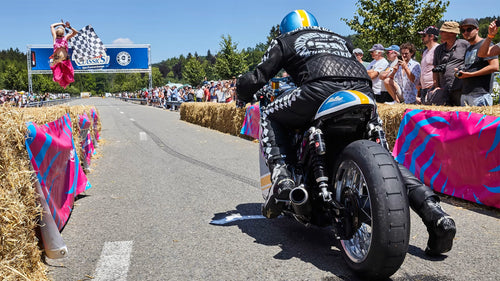
Every spring, the Sarthe region vibrates to the rhythm of a unique event where it's not the laps but the hours that count. The 24 Hours Motos du Mans is much more than a race: it's a monument of motorcycle endurance, an event where men and machines push their limits from one afternoon to the next. The opening round of the FIM Endurance World Championship (EWC), this classic attracts tens of thousands of enthusiasts every year. A deep dive into the history, format, and legend of the most French of endurance races.
Summary
- A Race Born Out of a Void (1978)
- The Bugatti Circuit, a Showcase for Endurance
- 24 Hours Motos or Bol d'Or: Not to be Confused
- The 24-hour Format, a Team Challenge
- Legendary Brands and Teams
- An Undiminished Popular Enthusiasm
- Summary Table
- FAQ — Frequently Asked Questions
A Race Born Out of a Void (1978)
The history of the 24 Hours Motos begins with a departure... that of another race. Until the mid-1970s, the Bugatti circuit hosted the legendary Bol d'Or, the oldest French endurance event. But in 1978, the Bol d'Or moved to the Paul Ricard circuit in the south of France, leaving Le Mans orphaned of its great motorcycle race. The Automobile Club de l'Ouest (ACO), organizer of the legendary 24 Hours of Le Mans car race, then decided to fill this void by launching its own twenty-four-hour motorcycle event.
The first edition was held in 1978 and saw the victory of the French duo Jean-Claude Chemarin and Christian Léon on a Honda RCB, a factory machine that then dominated world endurance racing. These two names are etched in stone: they embody the golden age of a discipline where the talent of the riders was as important as the reliability of the mechanics. As with other great classics such as the Daytona 200 or the Tourist Trophy, the race quickly forged its own identity and track record.
The Bugatti Circuit, a Showcase for Endurance
Beware of a common confusion: the 24 Hours Motos is not run on the same track as the 24 Hours of Le Mans car race. The car race uses the gigantic Circuit des 24 Heures (also known as the Sarthe circuit), which is 13.626 km long and combines permanent track with closed departmental roads. Motorcycles, on the other hand, race on the Bugatti circuit, a much shorter permanent track of 4.185 km, entirely located within the Le Mans enclosure.
Inaugurated in 1965-1966, the Bugatti is a technical circuit made up of long curves and heavy braking, demanding on both tires and brakes, which are put to the test for an entire day. Its compact configuration allows spectators to follow the action closely and offers teams tight management of relays and pit stops. It is an ideal setting for endurance, halfway between the pure speed of a modern Grand Prix track and the wear and tear of a marathon event.
🏍️ Want to hang a piece of this legend in your home? Discover our selection of motorcycle posters and prints to decorate your walls with the colors of the race.

The article celebrates a great historic race: a wall poster naturally extends the reader's attachment to this endurance legend.

24 Hours Motos or Bol d'Or: Not to be Confused
The two events are often mentioned in the same breath, and for good reason: they are the two great French classics of motorcycle endurance racing. But they should not be confused. The Bol d'Or, created much earlier (in 1922), is historically the older of the two; after its passage through Le Mans and then Paul Ricard, it is still contested today as a full round of the EWC. The 24 Hours Motos, born in 1978, is therefore the "younger sister" but remains inseparable from the Bugatti circuit and the city of Le Mans.
In practice, both races share the same twenty-four-hour format and both count towards the world championship, but they take place on different circuits, at different times of the season, and each cultivate their own atmosphere. Le Mans traditionally opens the season in the spring; the Bol d'Or often closes it in the autumn. Two events, two atmospheres, the same cult of mechanics pushed to the limit.
The 24-hour Format, a Team Challenge
Riding for twenty-four hours straight is impossible for a single person. That's the whole point of endurance: each motorcycle is entrusted to a crew of three riders (compared to two at the origin of the discipline) who relay at the handlebars, generally in stints of about an hour. While one rider laps, his teammates recover, while the mechanics prepare the pit stops: refueling, tire changes, or even replacement of pads or bodywork elements, all timed to the second.
The race serves as the opening round of the FIM EWC Endurance World Championship, of which Le Mans has been a pillar since the 2000s. There are mainly two categories: the premier EWC category, which brings together the most advanced factory motorcycles, and the Superstock (STK) category, reserved for machines closer to production models. This dual hierarchy allows private teams to shine against official teams. Consistency, strategy, and managing fatigue often take precedence over pure speed: here, you don't win in one lap, you win by never breaking the rhythm.
The figures are astounding. In the 2026 edition, the winning motorcycle completed 859 laps of the Bugatti circuit, covering nearly 3,600 kilometers in one day, with top speeds recorded at nearly 300 km/h. A performance that reminds us that an endurance machine must be as fast as a sports car and as enduring as a touring car like the Honda Gold Wing.
Legendary Brands and Teams
The list of winners of the 24 Hours Motos reads like a who's who of the Japanese industry. In 2024, by claiming its 15th victory at Le Mans, Suzuki took the lead in the brand rankings, ahead of Kawasaki and Honda, both long having around fourteen successes. This triumph bore the signature of the most iconic team in the discipline: the Suzuki Endurance Racing Team (SERT).
Founded in the early 1980s by Dominique Méliand, the SERT — now Yoshimura SERT Motul — is the most successful team in endurance history, with a total of thirteen world championship titles to its name. In 2024, its crew of Gregg Black, Étienne Masson, and Dan Linfoot won at Le Mans on the Suzuki GSX-R, a worthy heir to the sports bike that changed everything, the 1985 GSX-R750. Facing them were other legendary teams: Christophe Guyot's GMT94, long the standard-bearer for Yamaha, and the Kawasaki SRC team, multiple winners in the 2010s.
Since then, it has been the YART-Yamaha Official EWC Team that reigns supreme. Winners in 2025 and then in 2026, the Austrian team led by Karel Hanika and Marvin Fritz gave Yamaha its sixth victory in the Le Mans classic, proving that endurance remains a theater where the established order can be overturned from one edition to the next.
🏍️ A fan of a particular team or machine? Find our miniature motorcycles to collect your favorite models to scale.
An Undiminished Popular Enthusiasm
What makes the 24 Hours Motos a great classic is not just the sport: it's the atmosphere. Every spring, tens of thousands of spectators fill the stands and campsites of the Bugatti — 76,700 spectators for the 2026 edition, after a peak of 78,800 in 2024. Bikers from all over Europe, families, mechanics enthusiasts: the race is as much a popular festival as a high-level competition.
The most magical moment remains the night. When the light fades, the motorcycles' headlights pierce the darkness, the brakes glow red at the entrance to the bends, and the roar of the engines resonates differently. This is often when the race is decided, in the cold and fatigue, between extreme concentration and small mechanical miracles. This very special atmosphere brings Le Mans closer to the great gatherings of motorcycle culture, like what we describe about the Sturgis Motorcycle Rally or the legendary Paris-Dakar. One thing is certain: as long as machines run for twenty-four hours at Le Mans, the legend will continue to be written.
Summary Table
| Element | Detail |
|---|---|
| Creation | 1978, at the initiative of the Automobile Club de l'Ouest (ACO) |
| Circuit | Bugatti circuit of Le Mans, 4.185 km (not to be confused with the Sarthe circuit, 13.626 km, for the 24 Hours car race) |
| First winner | Jean-Claude Chemarin & Christian Léon (Honda RCB), 1978 |
| Championship | Opening round of the FIM Endurance World Championship (EWC) |
| Format | 24 hours, crews of 3 riders relaying, EWC and Superstock categories |
| Record brand | Suzuki, 15 victories (surpassed Kawasaki and Honda in 2024) |
| Most successful team | Suzuki Endurance Racing Team (SERT) / Yoshimura SERT Motul |
| Recent winners | 2024: Yoshimura SERT Motul (Suzuki) — 2025 & 2026: YART-Yamaha |
| Attendance | Around 76,000 to 79,000 spectators per edition |
📖 Also read: The Suzuka 8 Hours: The Great Mass of Japanese Endurance.
FAQ — Frequently Asked Questions
-
What is the difference between the 24 Hours Motos and the Bol d'Or?They are the two major French motorcycle endurance classics, but they are run on different circuits: the 24 Hours Motos takes place on the Bugatti circuit in Le Mans, while the Bol d'Or is held at the Paul Ricard circuit. Both count towards the FIM Endurance World Championship (EWC).
-
On which circuit are the 24 Hours Motos run?On the Bugatti circuit in Le Mans, a permanent track of 4.185 km. It should not be confused with the Sarthe circuit (13.626 km) used by the 24 Hours of Le Mans car race.
-
How many riders make up a crew in the 24 Hours Motos?Each motorcycle is entrusted to a crew of three riders who take turns at the handlebars for twenty-four hours. At the origin of the discipline, crews were composed of only two riders.
-
Which brand holds the record for victories at the 24 Hours Motos?Suzuki holds the record with 15 victories, achieved in 2024 to surpass Kawasaki and Honda. Yamaha has six successes in the event.
-
Do the 24 Hours Motos count towards a world championship?Yes. The race is the opening round of the FIM Endurance World Championship (EWC), which it traditionally inaugurates in the spring.