2791 mots | Temps de lecture : 13 minute(s)
Velocette: the small Birmingham firm that won the first world championship
Brand historiesVelocetteBritish motorcycles
Born in Birmingham in 1904 and settled at Hall Green since 1927, Veloce Ltd was never more than a small family firm, and yet it gave motorcycling its very first 350 world champion. In 1949, at the age of forty, Freddie Frith won all five Grands Prix he entered on a KTT Mk VIII; Bob Foster did it again in 1950. Then came the 499 cm³ Venom, the 41-horsepower Venom Thruxton built in just 1,108 examples, and that Montlhéry record: twenty-four hours at an average of 100.05 mph, on 18 and 19 March 1961. The firm died in February 1971.
Contents
- Hall Green: a family workshop in the heart of Birmingham
- The KTT and the invention of the foot gearchange
- 1949-1950: the first two 350 world titles
- Venom, Viper and Venom Thruxton
- Montlhéry 1961: 24 hours at over 100 mph
- The LE: the silent bike of the bobbies
- February 1971: the end of Hall Green
- Legacy: café racer, Ton-Up Boys and collector value
- Summary table
- FAQ
Hall Green: a family workshop in the heart of Birmingham
It all begins with a German immigrant. Johannes Gütgemann landed in England in 1876, aged nineteen, anglicised his name to John Taylor, then took the name John Goodman when he was granted British nationality in 1911. His firm, Taylor Gue, supplied the Ormonde Motor Co. before taking over its business at the end of 1904 and launching its first motorcycle, named Veloce, in 1905. The company would become Veloce Ltd and, in 1927, carried by its early racing successes and by orders it could no longer fulfil, it would move to Hall Green, in the southern suburbs of Birmingham — an address it would never leave.
Velocette was never a big factory. Where Triumph or BSA built on production lines, the little Birmingham firm assembled by hand, with an obsession for finish that would become its signature: deep black, gold lining, careful fitting. In 1924, Percy Goodman, the founder's son, drew up the firm's first single-cylinder engine with an overhead camshaft, the Model K, produced from 1925. That engine would carry the marque for half a century and write it, in its own way, into thehistory of motorcycling as a whole.
The KTT and the invention of the foot gearchange
Recognition came quickly. In 1926, Alec Bennett won the Isle of Man Junior TT on a 348 cm³ overhead-camshaft machine, more than ten minutes clear of his nearest rival, and Velocette took the team prize along the way. Two years later, Bennett did it again in the Tourist Trophy Junior of 1928, ahead of his team-mate Harold Willis.
Now that same Harold Willis, the firm's development engineer, had just perfected a device that would change motorcycling forever: the positive-stop foot gearchange, the lever that returns to centre after every gear change. It made its racing debut on the Velocettes of that very 1928 TT, before spreading to the production models, then being copied by the whole industry; today it is fitted to virtually every motorcycle in the world. Few marques can claim such a technical legacy.
In 1929, Veloce Ltd turned its winning racer into the KTT, a replica sold to the public — the Grand Prix bike available over the counter, long before the Japanese did it. The line culminated in the KTT Mk VIII unveiled at the motorcycle show in late 1938, with a frame using a swinging arm and Dowty Oleomatic air struts at a time when the competition was still running rigid frames. On works machines built to that layout, Stanley Woods gave Velocette the 1938 and 1939 Junior TTs, breaking seven years of Norton domination.
1949-1950: the first two 350 world titles
In 1949, the FIM organised the very first road racing world championship, six rounds and five classes: 500, 350, 250, 125 and 600 side-cars. It was the inaugural season of what would become the MotoGP world championship. In the 500 class, Leslie Graham won on an AJS; in the 250, the Italian Bruno Ruffo on a Moto Guzzi. And in the 350 cm³class, a forty-year-old crushed the field.
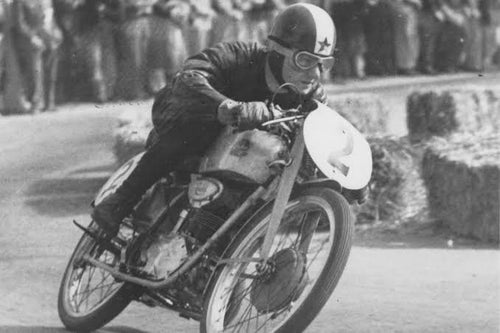
Freddie Frith, a veteran from Grimsby in Lincolnshire, ran a works KTT Mk VIII fitted with the new double overhead camshaft engine. He won the five 350 Grands Prix he entered — the Junior TT included — and took the title with a perfect score, comfortably enough to skip the final round at Monza. Freddie Frith thus became the very first 350 cm³ world champion in history, then hung up his leathers straight afterwards.
The following year, Velocette did it again. Bob Foster, nicknamed the “Cheltenham Flyer”, already the winner of the 1947 Junior TT at an average of 80.31 mph, took the 350 title in 1950 thanks to his wins in Belgium, the Netherlands and Ulster. Two world titles for a family business from Birmingham against the Italian armadas later found at Gilera or MV Agusta : the balance of power was absurd, and yet Hall Green won.
Venom, Viper and Venom Thruxton
Back to the road. In November 1955, Velocette introduced the Venom, a pushrod single of 499 cm³ (86 x 86 mm) producing 34 horsepower at 6,200 rpm for a top speed of 100 mph, or 160 km/h. Its little sister the Viper, launched at the same time, used the same architecture in 349 cm³. Two long, low machines with an inimitable exhaust note, which became favourites of the English clubmen.
The name that would go down in history came next. The Thruxton circuit, a former airfield near Andover, hosted long races for production machines — the Nine-Hour, then the 500 Miles. In 1964, Alan Harris and Howard German won the 500 class there on a Venom Clubman, with two more Velocettes completing the class podium. The marque immediately took the name for its flagship, unveiled at Earls Court in November 1964: the Venom Thruxton.
Big-valve cylinder head, Amal GP carburettor, clip-ons, rearsets, twin-leading-shoe front brake: the Thruxton put out 41 horsepower and came close to 120 mph in racing trim. It was built in only 1,108 examples. Its high point? The 1967 Production TT, the first running of the Isle of Man race reserved for production machines: Neil Kelly won the 500 class at an average of 89.89 mph with a fastest lap of over 91 mph, Keith Heckles following him at 89.15 mph. A one-two, and Velocette's last TT victory.
🏍️ Clip-ons, bare tank, single seat: if the Thruxton look speaks to you, take a look at Café Racer: motorcycle accessories and decor.
Montlhéry 1961: 24 hours at over 100 mph
This is perhaps the marque's maddest feat, and it happened in France. On 18 and 19 March 1961, on the banked oval of the Linas-Montlhéry autodrome, a Venom Clubman lightened by some fifty pounds — mudguards, lights, battery and speedometer removed — and wearing a full fairing designed by Doug Mitchenall, the man who would soon give us the production Veeline, set out to attack the 24-hour record. GP carburettor, megaphone exhaust: the machine circulated tirelessly at around 107 mph.
Eight riders took turns, an explosive mix of Englishmen and Frenchmen: Bertie Goodman, the managing director of Veloce Ltd himself, the journalist Bruce Main-Smith, young Alain Dagan, the fastest of them all, and above all Georges Monneret, then 55 years old, joined by his son Pierre Monneret. A crash cost half an hour of repairs. At the end of the twenty-four hours, the average came in at 100.05 mph, or 161.01 km/h, for roughly 2,400 miles swallowed in one go.
A 500 single had just held an average of over 160 km/h for a whole day; practice included, the engine had covered some 3,800 miles and came out of the strip-down intact. More than sixty years later, it is still a record nobody has ever taken back from a 500 single. Enough to stand up to the great endurance events such as the Bol d'Or or the 24 Heures Motos du Mans.

A bare wall is a bored garage. Hang up a poster that smells of hot oil, banked ovals and twenty-four hours flat out.
The LE: the silent bike of the bobbies
Picture the contrast. While its singles were screaming round the circuits, in 1948 Velocette launched the most improbable object in its catalogue: the LE, short for “little engine”. A water-cooled flat twin with side valves of 149 cm³, raised to 192 cm³ in 1951, shaft drive, leg shields, radiator, lever start. Top speed: 50 mph, about 80 km/h. Launch price: £126, when a BSA Bantam cost 76.
The public turned its back on this rather austere “motorcycle for everyone”, but one unexpected customer took to it in numbers: the British police. More than fifty police forces bought it, won over by its silence, its cleanliness and its docility on neighbourhood patrol — to the point of absorbing more than half of production. The officers, who saluted with a nod of the head because they could not let go of the handlebars, gave it its eternal nickname: the “Noddy bike”. Ironically, this strange machine became the marque's biggest commercial success, and the LE stayed in the catalogue until the very last day of Hall Green.
February 1971: the end of Hall Green
The 1960s proved fatal. Velocette tried to move beyond pure motorcycles with the Viceroy scooter (1960-1964): fewer than 700 sold, when the tooling had been financed by a £75,000 loan taken out in 1959, of which £45,000 was still owed at liquidation. The Vogue launched in 1963, an LE reclothed in polyester with twin headlamps, would reach only 381 examples. Two costly failures for a firm with no reserves at all.
Meanwhile, the market was shifting. The 1969 Honda CB750 Four redefined what a rider expected from a big machine, and the English industry collapsed one firm after another — the same wreck that would later carry off the Norton Commando and the Norton rotaries. In February 1971, a creditors' meeting voted for the voluntary liquidation of Veloce Ltd. The Goodman family would settle every last debt: to the very end, the firm kept its standing.
Legacy: café racer, Ton-Up Boys and collector value
Velocette did not survive, but its vocabulary did. The Venom Thruxton became one of the archetypes of the café racer, alongside the BSA Gold Star of the Ton-Up Boys and the Triumph Bonneville. In the Ace Café car parks, in the England of Rockers versus Mods, a Hall Green single set up to the millimetre was worth more than any speech.
Today, works KTT Mk VIIIs change hands for six figures at auction, the Thruxton sits in the pantheon of English singles alongside the Vincent Black Shadow and the Brough Superior SS100, and gatherings such as Goodwood still echo to that slow, heavy beat. Two world titles, an endurance record never beaten, an invention that became universal: for a small Birmingham firm, the tally is staggering.
🛠️ Caps, enamel plaques, old-school objects: the Vintage & Retro motorcycle section carries on the spirit of the English workshops of the sixties.
Summary table
| Key fact | Detail |
|---|---|
| Company | Veloce Ltd, Hall Green works, Birmingham (from 1927) |
| Origins | Ormonde taken over at the end of 1904, first “Veloce” motorcycle in 1905 |
| Major innovation | Positive-stop foot gearchange, Harold Willis, 1928 TT |
| Racing machine | KTT (1929), Mk VIII with swinging arm from late 1938 |
| 1949 world title | Freddie Frith, 350 cm³, 5 Grand Prix wins |
| 1950 world title | Bob Foster, 350 cm³ (Belgium, Netherlands, Ulster) |
| Venom (1955) | 499 cm³, 34 hp at 6,200 rpm, 100 mph |
| Venom Thruxton | 41 hp, 1,108 examples, one-two at the 1967 Production TT |
| Montlhéry record | 18-19 March 1961: 100.05 mph (161.01 km/h) over 24 h |
| LE | 1948, water-cooled flat twin, 149 then 192 cm³, British police |
| Closure | February 1971, voluntary liquidation of Veloce Ltd |
FAQ — Frequently asked questions
-
Who won the very first 350 cm³ world championship?Britain's Freddie Frith, on a Velocette KTT Mk VIII, in the inaugural season of 1949. At 40, he won all five 350 Grands Prix he entered and did not even need to race the final round at Monza.
-
Did Velocette win a second world title?Yes. In 1950, Bob Foster, nicknamed the “Cheltenham Flyer”, gave the marque a second consecutive 350 cm³ title thanks to his wins in Belgium, the Netherlands and Ulster.
-
What is the 24-hour record set by Velocette at Montlhéry?On 18 and 19 March 1961, a faired Venom Clubman ridden by eight men in relay covered 24 hours at an average of 100.05 mph, or 161.01 km/h, on the Linas-Montlhéry banked oval. No 500 single has taken that record back since.
-
What is a Velocette Venom Thruxton?It is the most highly developed version of the marque's 499 cm³ single, named after the English circuit of Thruxton. With 41 horsepower, a big-valve cylinder head and an Amal GP carburettor, it was built in only 1,108 examples and scored a one-two at the 1967 Production TT with Neil Kelly and Keith Heckles.
-
Who invented the foot gearchange?Harold Willis, Velocette's development engineer, perfected the positive-stop foot gearchange at the end of the 1920s. It made its racing debut on the Velocettes of the 1928 Tourist Trophy, before being copied by the whole industry.
-
Why did the British police ride the Velocette LE?Launched in 1948, the LE was a water-cooled flat twin of 149 then 192 cm³, with shaft drive, very quiet and very clean. More than fifty police forces adopted it for neighbourhood patrols, which earned it the nickname “Noddy bike”.
-
Why did Velocette close its doors?The commercial failures of the Viceroy scooter and the Vogue, the cost of developing them and the massive arrival of Japanese motorcycles got the better of the little firm. Veloce Ltd went into voluntary liquidation in February 1971, with the Goodman family settling all the debts.