2032 mots | Temps de lecture : 10 minute(s)
The Brough Superior SS100: "The Rolls-Royce of Motorcycles"
Contents
- George Brough, Obsessed with Perfection
- "The Rolls-Royce of Motorcycles": A Slogan Blessed by Rolls-Royce
- The SS100: Every Unit Guaranteed at 100 mph
- Luxury Assembled Twice, Almost Bespoke
- Lawrence of Arabia, the Struck Enthusiast
- Extreme Rarity and Auction Records
- The Modern Revival of the Brand
- Summary Table
- FAQ
George Brough, Obsessed with Perfection
The story begins in Nottingham, England. Son of manufacturer William E. Brough, who had been involved in motorcycles since 1902, young George Brough grew up surrounded by engines and workshops. But the son had grander—and, more importantly, more beautiful—ambitions than his father. In 1919, he launched his own brand and gave it a name with no false modesty: Brough Superior. Legend has it that William, annoyed, sarcastically asked if his own motorcycles were now to be called "Brough Inferior."
Where the nascent industry was already favoring mass production—the mechanization of motorcycles was in full swing in those years—George Brough chose the opposite path: that of absolute rarity and perfect finish. Every machine leaving his Haydn Road workshop had to be the fastest, most luxurious, and best-built of its era. It was a counter-current artisan's gamble, at a time when major British brands were aiming for mass appeal.
"The Rolls-Royce of Motorcycles": A Slogan Blessed by Rolls-Royce
The phrase that would define the brand did not come from George Brough himself, but from a journalist. In 1923, tester H. D. Teague, from The Motor Cycle magazine, test-rode a Brough Superior SS80 and described it as "the Rolls-Royce of Motorcycles." The comparison was too good not to use: Brough immediately incorporated it into his advertising.
The problem: at Rolls-Royce, the appropriation of their prestigious name was not appreciated. According to the most widely told version, a representative of the car manufacturer visited the factory to check if the workshop was worthy of the comparison. George Brough is said to have staged his workers in white coats and gloves, assembling engines like watchmakers. The delegate, impressed by this almost surgical cleanliness, reportedly gave his approval. Brough Superior thus obtained unique official endorsement in motorcycle history—a marketing argument worth its weight in gold.
The SS100: Every Unit Guaranteed at 100 mph
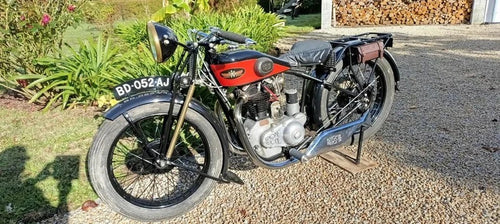
In 1924, George Brough unveiled his masterpiece: the SS100, for Super Sports 100. The name was not an empty promise. Each machine came with a certificate guaranteeing that it had exceeded 100 mph (approximately 160 km/h) in a real test, often ridden by Brough himself on the Brooklands track. A truly astonishing figure for the time, when most automobiles struggled to reach half that speed.
At the heart of the beast: a 998 cm³ V-twin overhead valve engine, supplied by specialist J.A. Prestwich (JAP) of Tottenham, producing around 50 hp. From 1936, the SS100 adopted an even more powerful Matchless V-twin engine. The motorcycle remained in the catalog until 1940, when the outbreak of war signaled the end of production. This pursuit of pure speed already heralded the spirit of the world's fastest motorcycles, decades before modern hypersport bikes.
🏍️ Want to display a legend in your home? Discover our selection of miniature motorcycles for collectors.

The item celebrates an ultra-rare and priceless motorcycle; a miniature is the accessible object that allows you to own a piece of the legend.

Luxury Assembled Twice, Almost Bespoke
What truly set a Brough Superior apart was its obsession with detail. The SS100 was one of the first truly "custom" motorcycles in the modern sense: Brough selected the best components from different suppliers rather than manufacturing everything himself, then assembled them according to the precise wishes of each client. Even the handlebars were individually bent to the buyer's physique.
Even more incredibly: each machine was assembled twice. A first assembly served to adjust all elements to perfection; the motorcycle was then completely disassembled, each part carefully painted or nickel-plated, before a final reassembly. A goldsmith's ritual that explains the price: £170 in 1925, equivalent to several years of a laborer's salary—the price of a small house. This dedication to craftsmanship is reminiscent of the great British twins that built the island's reputation.

Lawrence of Arabia, the Struck Enthusiast
No motorcycle is as intimately linked to a man as the Brough Superior is to Thomas Edward Lawrence, the mythical "Lawrence of Arabia." The officer and writer, hero of the Arab Revolt of 1916-1918, was an absolute enthusiast of the brand. He owned seven throughout his life, all of which he nicknamed "Boanerges" ("sons of thunder," a biblical reference) and numbered from George I to George VII.
On May 13, 1935, at 46 years old, Lawrence was riding his 1932 SS100 near his cottage in Clouds Hill, Dorset. To avoid two young cyclists who suddenly appeared on the narrow road, he swerved, was thrown, and fractured his skull. He never regained consciousness and died six days later, on May 19, 1935. A detail of immense significance: the neurosurgeon who treated him, Hugh Cairns, was so deeply affected by this death that he dedicated years to studying head injuries in motorcyclists—work considered pioneering in the history of the helmet. Long before current debates on choosing a good helmet, Lawrence's passing indirectly saved countless lives.

Extreme Rarity and Auction Records
Only about 383 SS100s were built between 1924 and 1940 (69 of them in 1925 alone), encompassing all engine types. Of this total, it is estimated that far fewer remain in roadworthy condition today. This extreme rarity, combined with the brand's prestige and the Lawrence myth, makes each example an absolute grail for collectors.
The result: dizzying prices in auction rooms. In March 2019, at H&H Classics at the National Motorcycle Museum in Birmingham, a 1930 SS100—sold as a dismantled "puzzle" in unrestored condition—reached a world record of £425,500 (approximately $561,000). A sum comparable to that of classic cars, confirming Brough's unique place in global motorcycle heritage.
🖼️ Prefer to display the legend on your walls? Browse our collection of motorcycle posters and prints.

The Modern Revival of the Brand
One might have thought the name was extinguished forever. Not so. In 2008, British specialist Mark Upham acquired the rights to the Brough Superior brand. Then, in 2013, he partnered with French designer Thierry Henriette, head of Boxer Design in Toulouse, to revive the legend. A completely new SS100 was unveiled at the Milan Show (EICMA) that year.
This contemporary reinterpretation maintains the spirit—luxury, handcrafted manufacturing, the V-twin—but steps into modernity with a liquid-cooled, double overhead camshaft engine, and small-series production from France. The new generation Brough Superior remains true to its motto: few units, a high price, and exceptional quality. Proof that a mythical name, like many other resurrected British legends, can cross nearly a century without losing its soul.

Summary Table
| Characteristic | Detail |
|---|---|
| Brand | Brough Superior, founded in 1919 by George Brough in Nottingham (England) |
| Model | SS100 (Super Sports 100), introduced in 1924 |
| Production | Approximately 383 units (1924-1940) |
| Engine | JAP 998 cm³ V-twin (~50 hp), then Matchless from 1936 |
| Guaranteed Performance | 100 mph (~160 km/h), tested for each machine |
| Original Price | £170 in 1925 (a fortune for the time) |
| Nickname | "The Rolls-Royce of Motorcycles" (H. D. Teague, 1923) |
| Famous Owner | T. E. Lawrence ("Lawrence of Arabia"), 7 units; died on his SS100 on May 19, 1935 |
| Auction Record | £425,500 (1930 SS100), H&H Classics, March 2019 |
| Revival | Rights acquired in 2008 (Mark Upham); new SS100 unveiled in 2013 with Boxer Design (Toulouse) |
FAQ — Frequently Asked Questions
-
Why is the Brough Superior called "the Rolls-Royce of motorcycles"?The phrase was coined in 1923 by journalist H. D. Teague of The Motor Cycle magazine to describe the brand's exceptional quality. George Brough then obtained Rolls-Royce's permission to officially use it in his advertising after a famous factory visit.
-
How fast could the SS100 go?Each SS100 was delivered with a guarantee that it had exceeded 100 mph, or approximately 160 km/h, during a real test—an extraordinary performance for the 1920s and 1930s.
-
What is the connection between the Brough Superior and Lawrence of Arabia?T. E. Lawrence, known as "Lawrence of Arabia," was a passionate enthusiast of the brand: he owned seven Brough Superiors. He died on May 19, 1935, six days after an accident while riding his SS100 near Clouds Hill, Dorset.
-
How many SS100s were made?Approximately 383 units were produced between 1924 and 1940, each almost custom-built. This extreme rarity explains the record prices achieved today at auction.
-
Does the Brough Superior brand still exist?Yes. The rights were acquired in 2008 by Mark Upham, and a completely new SS100 was unveiled in 2013 through a partnership with designer Thierry Henriette (Boxer Design, Toulouse). The brand still produces luxury motorcycles in small series.