1567 mots | Temps de lecture : 7 minute(s)
The Sturgis Motorcycle Rally: The World's Largest Biker Gathering
Summary
- The Origins: Pappy Hoel and the Jackpine Gypsies (1938)
- From a Local Race to a Global Phenomenon
- Harleys, Customs, and the Black Hills Backdrop
- An Institution of American Biker Culture
- Summary Table
- FAQ — Frequently Asked Questions
The Origins: Pappy Hoel and the Jackpine Gypsies (1938)
It all began with one man, Clarence "Pappy" Hoel. In 1936, this businessman from the small town of Sturgis, South Dakota, bought the local Indian Motorcycle dealership and immediately founded a club for enthusiasts, the Jackpine Gypsies Motorcycle Club. Two years later, on August 14, 1938, this club organized its first speed event, named the Black Hills Motor Classic. At that time, it was far from the major motorcycle gathering we know today: on that day, only nine riders took to a dirt track, watched by approximately 175 spectators.
The starting grid already tells a story: eight Indian machines and only one Harley-Davidson. It was precisely this latter, ridden by Johnny Spiegelhoff, who won the race. As everywhere in the United States at that time, the rivalry between the two major American manufacturers thrilled crowds, a confrontation found in the epic of Indian Motorcycle as well as that of Harley-Davidson. The event was primarily sporting, in the spirit of the great American dirt and board track classics like the mythical Daytona 200, featuring dirt track races, hill climb events, and acrobatics.
An interesting detail: Pappy's wife, Pearl Hoel, organized a "Gypsy Tour" from the very first edition, a collective ride through Custer State Park punctuated by a picnic. This sense of conviviality and sharing, as much as the competition, would become the DNA of the event.
From a Local Race to a Global Phenomenon
Growth was immediate and spectacular. By 1939, attendance soared, and by 1940, there were already some 5,000 visitors. Interrupted for a few years during World War II, the gathering resumed with even greater vigor and continued to grow decade after decade. In 1990, for the 50th anniversary, the 400,000 participant mark was surpassed: the event officially became South Dakota's largest tourist gathering. It was in 1991 that the event took its modern name, "Sturgis Rally and Races."
The peak was reached in 2015: for its 75th edition, the rally attracted an estimated record of 739,000 people, smashing the previous record of 633,000 visitors set in 2000 during the 60th anniversary. Normally, attendance hovers around 500,000 bikers every August, for a town that, the rest of the year, has only about 7,000 inhabitants. It's safe to say that Sturgis literally changes dimension for about ten days, with the event traditionally starting on the first Friday of August.
These colossal figures are accompanied by enormous economic impact, estimated at around 800 million dollars in annual revenue. For tens of thousands of bikers, reaching Sturgis is a pilgrimage: they come from across the continent on two wheels, transforming the journey into a true adventure. If the idea of covering thousands of miles appeals to you, our 10 essential tips for a successful motorcycle road trip come at the perfect time. This culture of the great American road trip is inseparable from the imagery of the chopper and the movie Easy Rider.
🏍️ Want to display the spirit of big gatherings at home? Discover our selection of motorcycle posters and prints for bikers.

Harleys, Customs, and the Black Hills Backdrop
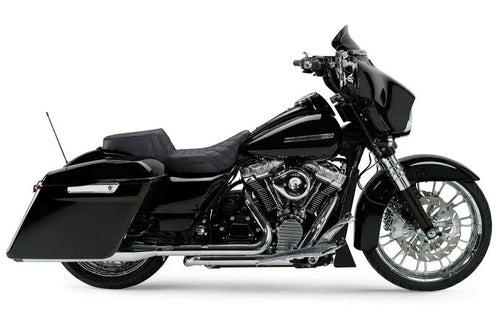
While the first winner rode a Harley against a majority of Indians, the balance of power has changed significantly. Today, Sturgis has become the temple of Harley-Davidson and custom motorcycles. In the streets, the rumble of V-twins is constant: gleaming choppers, chrome-plated baggers, minimalist bobbers, and unique creations from custom workshops are seen everywhere. To understand this art of extreme customization, our guide on the bobber motorcycle details this "less is more" philosophy so dear to Americans.
Along the legendary Main Street, closed to regular traffic, stands, concerts, custom contests, and exhibitions line the way. But Sturgis is also a breathtaking backdrop: the Black Hills of South Dakota offer some of the most beautiful winding roads in the country. Just a short ride away, bikers head out to iconic sites like Mount Rushmore, the Needles Highway, or the Iron Mountain Road with its hairpin turns. The nearby town of Deadwood, steeped in Wild West history, completes the picture.
For the nightlife, huge campsites like the famous Buffalo Chip act as veritable festivals, featuring rock and metal headliners. You'll find all the biker folklore: leather, patches, tattoos, and the famous tradition of the guardian bell. A fascinating, sometimes edgy, world that is also associated with the imagery of major biker clubs and gangs, even if the gathering remains primarily a gigantic, family-friendly celebration.
🏍️ To proudly display your passion like the Sturgis veterans, check out our collection of biker patches and emblems.

Patches and emblems are a cornerstone of the clothing folklore at biker rallies; the CTA is embedded in the ambiance section.
An Institution of American Biker Culture
In nearly 90 years, Sturgis has evolved from a small provincial race into a cultural monument. Pappy Hoel's legacy has been officially recognized: the Jackpine Gypsies were inducted into the Motorcycle Hall of Fame in 1997, and Clarence Hoel himself entered the AMA Hall of Fame in 1998. Remarkably, the founding club still owns and maintains the tracks, the hill climb course, and the infrastructure around which the rally was born.
Sturgis alone embodies the American two-wheeled dream, that image of freedom forged by cinema and legendary motorcycle figures. It's the same world as Steve McQueen, "the King of Cool", the crazy stunts of Evel Knievel, or the revolution of American riding embodied by Kenny Roberts Sr. Today, simply saying the word "Sturgis" is enough to conjure, for any enthusiast worldwide, the image of a sea of chrome sweeping over the Black Hills: the ultimate demonstration that motorcycling is much more than a means of transport; it's a culture and a brotherhood.
Summary Table
| Element | Verified Detail |
|---|---|
| Founder | Clarence "Pappy" Hoel |
| Organizing Club | Jackpine Gypsies Motorcycle Club |
| First Edition | August 14, 1938 |
| Original Name | Black Hills Motor Classic |
| First Race | 9 riders, ~175 spectators |
| Location | Sturgis, South Dakota (Black Hills) |
| Period | August (starting 1st Friday, ~10 days) |
| Attendance Record | ~739,000 visitors (2015, 75th edition) |
| Usual Attendance | Around 500,000 bikers |
| Economic Impact | ~$800 million / year |
FAQ — Frequently Asked Questions
-
Who founded the Sturgis rally?The rally was founded by Clarence "Pappy" Hoel, leading his motorcycle club, the Jackpine Gypsies, of which he was a cornerstone in the 1930s.
-
In what year was the first Sturgis rally held?The very first edition took place on August 14, 1938, under the name Black Hills Motor Classic, with only 9 riders and approximately 175 spectators.
-
How many people attend the Sturgis rally?Attendance averages around 500,000 bikers, with a record estimated at 739,000 visitors in 2015, during the 75th edition.
-
Where does the Sturgis Motorcycle Rally take place?It takes place in Sturgis, a small town in South Dakota, USA, in the heart of the Black Hills region, every August.
-
Why is Sturgis associated with Harley-Davidson?Even though the rally was founded by Indian riders, over the decades it has become the great temple of custom motorcycles and Harley-Davidson culture.