1777 mots | Temps de lecture : 8 minute(s)
The Yamaha YZF-R6 (1999): the benchmark 600 supersport
Summary
- Born in the wake of the R1
- A 599 cm³ 4-cylinder that only lives at high RPM
- A sharp Deltabox chassis inherited from the R1
- A fully embraced track vocation
- Queen of the Supersport World Championship
- The circuit weapon for young riders
- Summary table
- FAQ — Frequently asked questions
Born in the wake of the R1
When the Yamaha YZF-R6 was unveiled for the 1999 model year, it arrived with an overwhelming pedigree: that of the YZF-R1, launched a year earlier in 1998, which had just redefined what a production sportbike could be. Where the R1 had crushed the 1000cc category, the R6 was tasked with applying the exact same philosophy — extreme lightness, compactness, and aggressiveness — to Europe's best-selling class: the 600 supersport. To fully grasp the brand's DNA, one must review the entire history of Yamaha, a brand that has always known how to transform its racing expertise into road machines.
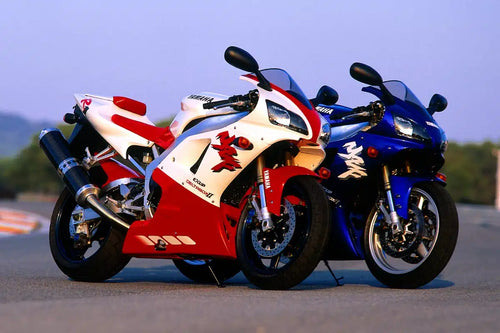
The R6 is therefore not just another 600. It was designed from the outset as the radical little sister of the R1, a version that sought neither comfort nor versatility, but pure performance. Its angular silhouette, aggressive dual headlights, and high-perched passenger seat clearly stated its purpose: this was a motorcycle designed around the stopwatch, in the lineage of uncompromising Yamaha sportbikes such as the famous RD500LC, a Grand Prix bike for the road.
A 599 cm³ 4-cylinder that only lives at high RPM
The heart of the R6 is its engine: an inline 4-cylinder of 599 cm³, liquid-cooled, with a double overhead camshaft and 16 valves. On paper, Yamaha announced a figure that caused a sensation at the time: 120 hp at the crankshaft, at a stratospheric 13,000 rpm. The R6 thus became the first production 600 cm³ four-cylinder to claim more than 100 hp in its original version, a symbolic milestone that revolutionized the category. On the dyno, at the rear wheel, the bike delivered closer to 99 hp — a classic discrepancy between manufacturer claims and actual measurements — without diminishing the achievement.
But the raw number doesn't tell the whole story. What makes this engine legendary is its redline among the highest in the category, peaking around 15,500 rpm. Torque, on the other hand, is meager at low RPM: barely more than 60 Nm, and especially nothing before 10,000 rpm. The R6 demands to be revved, kept in the high RPMs, exploited in the last thousands of RPM where it screams and transforms into a rocket. It is a refined, demanding, and exhilarating engine: misunderstood, it seems hollow; well-ridden, it becomes magical. This pursuit of high RPM, in spirit, is reminiscent of the quest for technical perfection of a masterpiece like the Honda NR750 with oval pistons.

A sharp Deltabox chassis inherited from the R1
A finely tuned engine is nothing without a chassis to match, and that's where the kinship with its bigger sister becomes evident. The R6 is built around an aluminum Deltabox frame, the perimeter beam architecture that is Yamaha's trademark and which the R1 had taken to a higher level. The result is an ultra-compact, light, and rigid package, with a contained dry weight of around 169 kg (approximately 190 kg wet) which places it among the most nimble 600s of its generation.
The suspension follows the same logic: 43 mm telescopic fork at the front, monoshock at the rear, geometry oriented towards agility with a short wheelbase and sharp rake. The R6 drops into a lean with disconcerting ease, changes direction with a simple press, and provides surgical precision that rewards clean riders. This is exactly the kind of handling you learn to master by refining your line, as explained in our guide on how to corner a motorcycle like a pro.
A fully embraced track vocation
Unlike many rivals who sought a road-track compromise, the first-generation R6 fully embraced an uncompromising track vocation. Very forward riding position, weight on the wrists, low handlebars, hard seat: on the open road, at a cruising pace, it is uncomfortable and frustrating. Its natural habitat is the circuit, where its insane revs, biting brakes, and telepathic chassis can finally be exploited.
This radicality is a choice, not a flaw. The R6 is for those who want a true road-legal race machine, in the grand tradition of race-replicas inaugurated by the 1985 Suzuki GSX-R750. It demands commitment, technique, and appropriate gear — because circuit riding means impeccable protection, starting with the choice of a good helmet.
🏍️ To show your passion for the tuning fork every day, check out our Yamaha iPhone cases.
Queen of the Supersport World Championship
It was in competition that the R6 built its legend. The Supersport World Championship, the flagship category for 600cc four-cylinders, quickly became its kingdom. As early as the 2000 season, German rider Jörg Teuchert won the world title on a YZF-R6, initiating a long series of successes. French rider Fabien Foret then triumphed in 2002, before riders like British Cal Crutchlow (2009) and his compatriot Chaz Davies (2011) continued the dynasty.
Over the years, the R6 accumulated crowns and established itself as the most titled motorcycle in Supersport World Championship history, with a total of ten rider titles achieved between 2000 and 2022 — including six consecutive titles from 2017 to 2022, driven by champions such as Lucas Mahias, Sandro Cortese, Andrea Locatelli, and Dominique Aegerter. This overwhelming dominance, reminiscent of Yamaha's grip in Grand Prix racing described in our article on Yamaha in MotoGP, made the R6 the absolute benchmark against rivals like the Honda CBR600 or the Kawasaki ZX-6R.
The circuit weapon for young riders
Beyond the podiums, the R6 has become an object of cult worship for an entire generation of riders. Its aggressive aesthetics, characteristic high-rev howl, and affordable used price have made it the preferred circuit weapon for young riders, the bike on which they learn to drag a knee, read a line, and push their limits during track days.

The R6 is a cult Yamaha sportbike; the Yamaha iPhone case allows the passionate reader to display the brand daily, a natural product link already initiated by a CTA.
It also sparked vocations: how many future speed riders made their first starts on an R6, before dreaming bigger, as we discuss in our article on how to become a professional motorcycle racer? Today, the first generation (1999-2002) has entered sporting heritage alongside great Italian supersport bikes like the Ducati 916. A status of icon that remains undiminished.
🏍️ Want to keep the legend alive on your shelf? Discover our selection of miniature motorcycles.
Summary table
| Characteristic | Yamaha YZF-R6 (1999) |
|---|---|
| Launch year | 1999 (1st generation 1999-2002) |
| Engine | Inline 4-cylinder, DOHC, 16 valves, liquid-cooled |
| Displacement | 599 cm³ |
| Claimed power | 120 hp at crankshaft at 13,000 rpm (≈ 99 hp at wheel) |
| Redline | Around 15,500 rpm |
| Frame | Aluminum Deltabox (R1 philosophy) |
| Weight | ≈ 169 kg dry / ≈ 190 kg wet |
| Top speed | ≈ 255 km/h |
| Vocation | Track-oriented supersport / circuit |
| Achievements | Most titled motorcycle in Supersport World Championship (10 rider titles) |
FAQ — Frequently asked questions
-
How much power does the 1999 Yamaha YZF-R6 produce?Yamaha claimed 120 hp at the crankshaft at 13,000 rpm, making it the first production 600cc four-cylinder to exceed 100 hp in its original version. At the wheel, actual measurements hovered around 99 hp.
-
Why is the R6 considered a "peaky" motorcycle?Because its 599cc engine delivers almost nothing at low RPM and only expresses its full potential in the very high revs, with a redline peaking around 15,500 rpm. It needs to be kept in the high RPMs to be exploited, which makes it demanding but exhilarating.
-
What is the connection between the R6 and the Yamaha R1?The R6 is the 600cc supersport version of the R1, launched a year earlier in 1998. It adopts the same philosophy: extreme lightness, compactness, and an aluminum Deltabox frame, applied to the 600cc category.
-
Was the YZF-R6 a good race bike?Yes, it even became the most titled motorcycle in the history of the Supersport World Championship, with ten rider titles won between 2000 and 2022. Jörg Teuchert gave it its first world title in 2000, followed notably by Fabien Foret (2002), Cal Crutchlow (2009), and Dominique Aegerter (2021-2022).
-
Is the first-generation R6 suitable for road use?It can be ridden on the road, but its very sporty position, firm seat, and engine that only comes alive at high revs make it uncomfortable for relaxed cruising. Its true playground remains the circuit, for which it was designed.