2338 mots | Temps de lecture : 11 minute(s)
The Manx Grand Prix: the amateurs' Tourist Trophy, on the very same Mountain Course
Races & circuitsIsle of ManRoad racing
On 20 September 1923, thirty-one starters set off on the Mountain Course for the Manx Amateur Road Races: Les Randles won on a Sunbeam 500 at an average of 52.77 mph. Renamed the Manx Grand Prix in 1930, the event became the antechamber to the Tourist Trophy, where Geoff Duke, Bob McIntyre, Phil Read and later Steve Hislop and Carl Fogarty learned their trade. Same 60.72 km lap and 219 corners, same total absence of run-off: more than a hundred riders have lost their lives there. In 2026, the Festival of Motorcycling runs from 16 to 28 August.
1923: the amateurs' revenge
In the early 1920s, the Tourist Trophy was already a monster. Factory teams fielded specially prepared machines and paid riders, and privateers were being methodically wiped off the grids. In 1921, the Manx Motor Cycle Club asked the ACU for an event reserved for amateurs. Flat refusal. It would take another two years for the idea to come off.
On 20 September 1923, the Manx Amateur Road Races — officially the « Manx Amateur Motor Cycle Road Race Championships » — finally got under way. Thirty-one starters, two categories combined in a single race: 500 and 350 cc. Five laps, 188.75 miles (about 304 km), and victory for Les Randles on a Sunbeam 500 in 3 hr 34 min 32 s, at an average of 52.77 mph (84.9 km/h). The race went to six laps as early as 1926, and a separate Junior event appeared in 1928.
But defining an “amateur” turned into an administrative nightmare. After years of protests and several high-profile disqualifications, the organisers changed tack in 1929: the event was renamed the Manx Grand Prix, and the first edition under that name was run in 1930. The rules no longer excluded professionals on principle, they excluded experts : you had to be a British or Irish subject, hold a licence, and neither have raced an international road race nor held a world record since 1920. More than a hundred entrants turned up, and the winner set a lap record at 71.13 mph (114.5 km/h). Among the newcomers at that first MGP was a certain Freddie Frith, third in the Junior on a Velocette KTT 350 at 60.34 mph: he would go on to win the Junior Manx Grand Prix in 1935, five TTs, and become the first 350 cc world champion in 1949.
The same Mountain Course, down to the metre
That is where the whole singularity of the event lies: there is no “lite” version of the course. The Mountain Course itself has not changed: 60.72 km of public roads and 219 corners. Start in front of the TT Grandstand in Douglas, clockwise, stone walls, kerbs and houses right at the roadside, then the long climb towards Snaefell up to the highest point at 422 metres above sea level, near the 31st Milestone, just before the Brandywell junction. The course has hosted motorcycle racing since 1911.

Tarmac, stone walls and not a gram of run-off: hang this poster above your workbench and your hallway takes on the air of a Manx paddock.
No other meeting on the calendar plays in this category. The Nürburgring Nordschleife is shorter, the Assen TT is a proper closed circuit. Here, a Manx Grand Prix newcomer takes on exactly the same tarmac, the same bumps and the same markers as the TT stars a few weeks earlier. Learning the course takes dozens of reconnaissance laps; riders measure it in years, not sessions.
🏍️ The Mountain Course has fed generations of poster artists and photographers: you'll find that road racing imagery in our motorcycle posters and prints.

The antechamber to the Tourist Trophy
The Manx Grand Prix roll of honour reads like a list of previews. Geoff Duke won the Senior Clubmans TT and the Senior Manx Grand Prix in 1949, the latter with both lap and race records; Norton signed him as a works rider straight afterwards and he won the Senior TT 1950 , again breaking the race and lap records. Bob McIntyre won the Junior Manx Grand Prix in 1952 on an AJS 7R: five years later he took the Junior and Senior TT double and set the first lap at over 100 mph on the Mountain Course. Phil Readwon the Senior Manx Grand Prix in 1960 at the age of 21, at his third attempt and on a privateer Manx Norton, then took the Junior TT 1961 on his very first appearance at the TT.
The talent machine went up another gear with the permanent return of the Newcomers (beginners) races in 1978, one of the very first of which was won by Phil Mellor . The 1983 Junior Newcomers podium has stayed famous: Robert Dunlop, the younger brother of Joey Dunlop, ahead of Steve Hislop and Ian Lougher — three future TT winners in the same bunch. Two years later, a young Englishman named Carl Fogarty, the future four-time Superbike world champion, won the Lightweight Newcomers in 1985. Next came Phillip McCallen in 1988 and Ryan Farquhar in 1999, while Rob McElnea and Adrian Archibald also took the Manx route to the TT.
Moving up a level is not optional, either. The winner of the Senior Manx Grand Prix receives theA.B. Crookall Trophy, donated back in 1923 by a former Mayor of Douglas, and by convention it can only be won once: the recipient must then enter the TT and can only come back to the Manx on classic machines. The event is literally designed as an airlock.
Late August, the classics and a different atmosphere
The calendar clearly separates the two meetings: the Tourist Trophy occupies late May and early June, while the Manx Grand Prix is traditionally run in late August-early September. Cut to nine days in 2022, it has been back to a fortnight format since 2025.
The “classic” dimension goes back a long way: the first races for historic machines appeared at the Manx Grand Prix as early as 1983. In 2013, the Manx government took over the promotion of those classic races under the name Classic TT and folded them into a Festival of Motorcycling shared with the MGP. The formula sent attendance soaring, from about 9,000 visitors in 2012 to more than 15,000 in 2016. The Classic TT ran from 2013 to 2019, disappeared, then came back in 2025.
One notable change for 2026 : the classic categories are leaving the Manx Grand Prix programme, which refocuses on modern machines — Sportbike, Supersport, Junior and Senior — while the Classic TT becomes an event in its own right again, with its Historic Junior and Senior, its Formula One, its Lightweight races and two new ones: a Junior 600 and an Ultra Lightweight open to 125 cc two-stroke Grand Prix machines as well as 400 cc four-strokes. The two meetings share the same fortnight, from 16 to 28 August 2026, with six days of qualifying then a week of racing — and a parade celebrating the 30-year career of John McGuinness on 28 August.
The atmosphere is the other big argument: an open paddock, club riders who build their own bikes, some forty awards handed out every year between finisher medals and silver or bronze replicas, parades of collectors' machines and a Manx 3-day Trial alongside. It is closer to the spirit of a motorised heritage gathering than of a grand prix under glass.
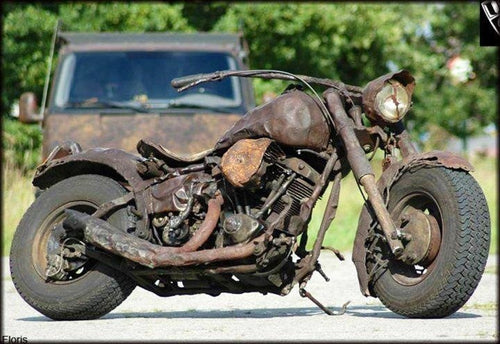
🏍️ To carry on this post-war road racing aesthetic, take a look at our vintage and retroselection.
Same circuit, same bill
That is the brutal corollary of the “same course”: the Manx Grand Prix is not a watered-down version of the TT. The walls, the poles, the kerbs and the near-total absence of run-off are identical. Tragedy even came before the first race: during practice in September 1923, the Manx rider Ned Brew was killed at Hillberry, before the first start had even been given.
The figures say the rest. Between 1911 and 2025, the Mountain Course has claimed the lives of 270 riders in official practice or in racing, across all events (TT, Manx Grand Prix, Clubmans TT). Depending on the count, more than a hundred of those deaths belong to the Manx Grand Prix alone. The event has paid its toll right up to very recent times, as in 2024 with the death of Irishman Louis O'Regan, who crashed at Kate's Cottage during the first qualifying session.
And the speeds have never stopped climbing. Phil Haslam set the Manx Grand Prix's first lap at over 100 mph in 1973 (102.18 mph), Mike Seward went past 110 mph in 1986, Phil Hogg dropped under 20 minutes a lap in 1988 at 114.02 mph (183.5 km/h), and Tommy Clucas broke 120 mph in 2004. The outright event record belongs to Michael Evans, who covered the 60.7 km in 18 min 25.495 s in 2017 on a Suzuki GSX-R 750, an average of 122.866 mph (197.7 km/h). An “amateur race” average that would make plenty of circuits blush, and a reminder that on the island, as on the Guia circuit in Macau, mistakes are not up for negotiation.
Summary table
| Item | Verified detail |
|---|---|
| First edition | 20 September 1923 |
| Original name | Manx Amateur Road Races (« Manx Amateur Motor Cycle Road Race Championships ») |
| First winner | Les Randles, Sunbeam 500 cc, 5 laps / 188.75 miles, 52.77 mph |
| Renaming | Manx Grand Prix, decided in 1929, first edition under that name in 1930 |
| Course | Snaefell Mountain Course, identical to the Tourist Trophy's |
| Length | 60.72 km (37.73 miles), 219 corners, high point at 422 m |
| Dates | Late August-early September (the TT is run in late May-early June) |
| Newcomers races | Permanently reinstated in 1978 |
| Classic classes | Since 1983; Classic TT created in 2013, back in 2025, standalone in 2026 |
| Lap record | Michael Evans, 18 min 25.495 s at 122.866 mph (197.7 km/h), Suzuki GSX-R 750, 2017 |
| Human toll | 270 riders killed on the Mountain Course between 1911 and 2025, across all events |
| 2026 edition | Festival of Motorcycling from 16 to 28 August; modern MGP + separate Classic TT |
FAQ — Frequently asked questions
-
Is the Manx Grand Prix really run on the same circuit as the Tourist Trophy?Yes, down to the metre. Both events use the Snaefell Mountain Course, 60.72 km and 219 corners of public roads, with a start in front of the TT Grandstand in Douglas.
-
When was the Manx Grand Prix created, and under what name?The first race took place on 20 September 1923 under the name Manx Amateur Road Races. The event was renamed Manx Grand Prix in 1929, the first edition under that name being run in 1930.
-
Which great riders started out at the Manx Grand Prix?Geoff Duke (Senior 1949), Bob McIntyre (Junior 1952) and Phil Read (Senior 1960) won there before triumphing at the TT. The Newcomers races unearthed Robert Dunlop, Steve Hislop, Ian Lougher, Phillip McCallen and Carl Fogarty.
-
Is the Manx Grand Prix as dangerous as the TT?The level of risk is the same, since the circuit is identical: walls, poles and no run-off. Between 1911 and 2025, the Mountain Course claimed the lives of 270 riders across all events, more than a hundred of them at the Manx Grand Prix alone, depending on the count.
-
What changes for the 2026 edition?The classic categories are leaving the Manx Grand Prix programme, which concentrates on modern machines, while the Classic TT becomes a standalone event again with two new races, Junior 600 and Ultra Lightweight. The two share the Festival of Motorcycling from 16 to 28 August 2026.